Recipe: Brown Banana Recon

Banana Bread

I’ve been making this banana bread for years. The fun part about it being that it started as a “real” recipe, but I’ve modified it so much over the years that I eventually gave up on the penciled-over version and typed up my own. My family loves this bread and I hope you’ll like it, too.

My Best Banana Bread
by Jennifer Ofenstein

1/2 c. or 1 stick of butter, room temp
1 cup sugar
2 eggs
1/8 tsp salt
1 tsp baking soda
2 cups flour
3 ripe bananas (the riper, the better!)
1/2 cup chopped pecans or walnuts

Spray or grease one loaf pan. Preheat oven to 275 degrees F.

Cream sugar and butter together. Add eggs one at a time, stirring well after each addition. In another bowl, mix together dry ingredients. Stir into sugar/butter mixture. Stir in ripe bananas, gently mashing them into the bread mixture as you go. If using a mixer, briefly use the lowest setting, making sure not to over-mix; the bananas should be a little lumpy. Stir in nuts.

Bake for 90 minutes. Cool on a wire rack. Eat warm, room temp or toasted with butter. Cool completely before storing.

also posted on the LiveJournal Community myflistcooks and cut out + keep

Way Back Craft: Ariel’s Blanket

Ariel's Blanket Ariel's Blanket - The original blanket
Queue this pattern on Ravelry!

Printable Pattern

Ariel’s Blanket was made as a replacement for a special little girl that had loved her blanket to pieces.

Her mom found me online through my first crafty website, Jen’s Crochet & Crafts and we later met so she could show me the blanket and I could meet her daughter. I agreed to make it, if she’d pay for the yarn and make a donation to the blanket charity I volunteer for, The Linus Connection. She agreed and the replacement process began.

The blanket is a recreation made as close to the original design as possible. It was my great pleasure to crochet this for Ariel. It’s been at many years now, since I made Ariel’s Blanket. I hope she still has it, and loves it as much as she did the day I gave it to her!

Red Heart Baby Sport Pompadour Yarn: small
amount blue, yellow, green, peach & pink
(approx. 1 – 1½ oz.), 40 ounces white
For one square: small amount for center color,
approx. 2 oz white)

PC= Popcorn
Ch 3 counts as DC in PC st
Size “F” Hook

Finished Blanket is approximately 44″ x 54″

Row 1: Starting with center color, Ch 6, join with sl st. Ch 1, 12 sc in loop. Join with sl st.

Row 2: Ch 3, 4 dc in beg sc [drop loop from hook, insert hook in top of first dc, pull loop through to make first PC] ch 4, sk 1 sc, 5 DC in next sc, follow [ ], ch 4 around until you have 6 PC.

Row 3: ch 1, sc in same st. 7 dc in ch sp, sc in petal join st around. (6 “Petals”)

Row 4: ch 1, sc in same st, [ch 5, sc in next sc] around, join with beg sc with sl st.

Row 5ch 3, 4 dc in first ch sp. [In next sc: Dc, ch 3, dc. In next ch sp: 4 dc. Dc in sc. In ch sp: 3 dc, ch 3, 3dc] Dc in sc, 4 dc in ch sp. Repeat [ ], join with sl st to top of beg ch 3. Finish off.  (This seems very odd, but it works out!)

You should now have a square with equal sides, 9 stitches per side with a ch 3 in each corner.

Row 6: Join white in any corner sp. Ch 3, 2 dc, ch 3, 3 dc in same corner space. Ch 1. {[Dc in each of the next 3 dc. Ch 1] Repeat [] to corner space. In next corner space, 3 dc ch 3, 3 dc,ch 1}, Repeat {} around. Join with sl st at beg ch 3.

You should now have 5 clusters of 3 dc with a chain sp between on each side with ch 3 in each corner.

Row 7 & 8: Sl st to corner sp ch 3, 2 dc, ch 3, 3 dc. {3 dc in ch sp to next corner. 3 dc, ch 3, 3 dc in corner}. Repeat {} around. Join with sl st at the top of beg ch 3.

Row 9: (do not sl st to corner) ch 3 (counts as first dc), 1 dc in each dc to corner. {[3 dc, ch 3, 3 dc in corner], 1 dc in each dc to corner}. Repeat {} around.

(for added variety, row 10 can also be in a contrasting color)

Row 10: ch 3, PC in next st, 1 dc, PC, 1 dc, (3 dc, ch 3, 3 dc in all corners), 1 DC, pc, 1 dc, PC around.

Row 11: ch 3, DC in each st around, (3 dc, ch 3, 3 dc in corners).

Row 12: ch 1, sc in each st around, 3 sc in corners. Finish off.

FOR BLANKET PATTERN
Make 20 squares. Join squares 4×5 either with whip st or sc. Add border.

Border: ch 3 counts as first stitch

cluster = 3 dc, ch 2, sc in 1st ch, 3 dc

(Here, your cluster is 3 double crochets with 2 chain stitches, then you single crochet in the first chain stitch you just made. This makes a point in the middle of the cluster. You then make 3 more double crochets to finish the cluster.)

Join white in second sc of corner, ch 3, 2 dc, ch 2, sc in first ch, 3 dc, skip 1 sc, sc in next ch, (cluster, sk 1 sc, sc in next ch, cluster), around.

Each square should have 6 clusters, not counting corner clusters.

Join with sl st, finish off, weave in ends.

Happy crafting!

Add your Sewhooked-related photos to my flickr group and you might be featured in a future post!

Photobucket

Sewhooked Shop | FB | SHFB | Flickr | Twitter

This is part of my “Way Back Craft” series’; patterns, crafts, tutorials and general crafty memories before the days of the blog.

Ariel's Blanket by Cathie Morales

Back To School Craft: Book Cover from a Fabric Remnant

Back to School Book Cover from Fabric Remnant

My eighth-grader brought an Algebra book home for the first time yesterday because it needed a cover. It’s huge, really huge, weighing in at a whopping six pounds (what, I was curious!).

The paper book covers of yesteryear are truly a thing of the past, something I learned a couple of years back when I suggested recycling a brown paper bag, just like I had when I was in school. Ah, the brown paper cover! All that real estate for doodling and scribbling down phone numbers or bits of song lyrics.

The look of shock and horror on my kiddo’s face was enough to tell me that, sadly, grocery bags are O-U-T, and stretchy fabric covers are IN.

The one-size-fits-all stretchy fabric cover we picked up with school supplies did not, despite the packaging promise, fit the mammoth math book.

We came up with a quick and easy solution with a project we’ve used a few times before: a fabric book cover, custom-made from a cotton remnant.

Let’s do it!

Measure out the remnant for your book, making sure that it is at least 2″ wider on top and bottom (4″ total) and several inches longer on each side than the book when it is opened.

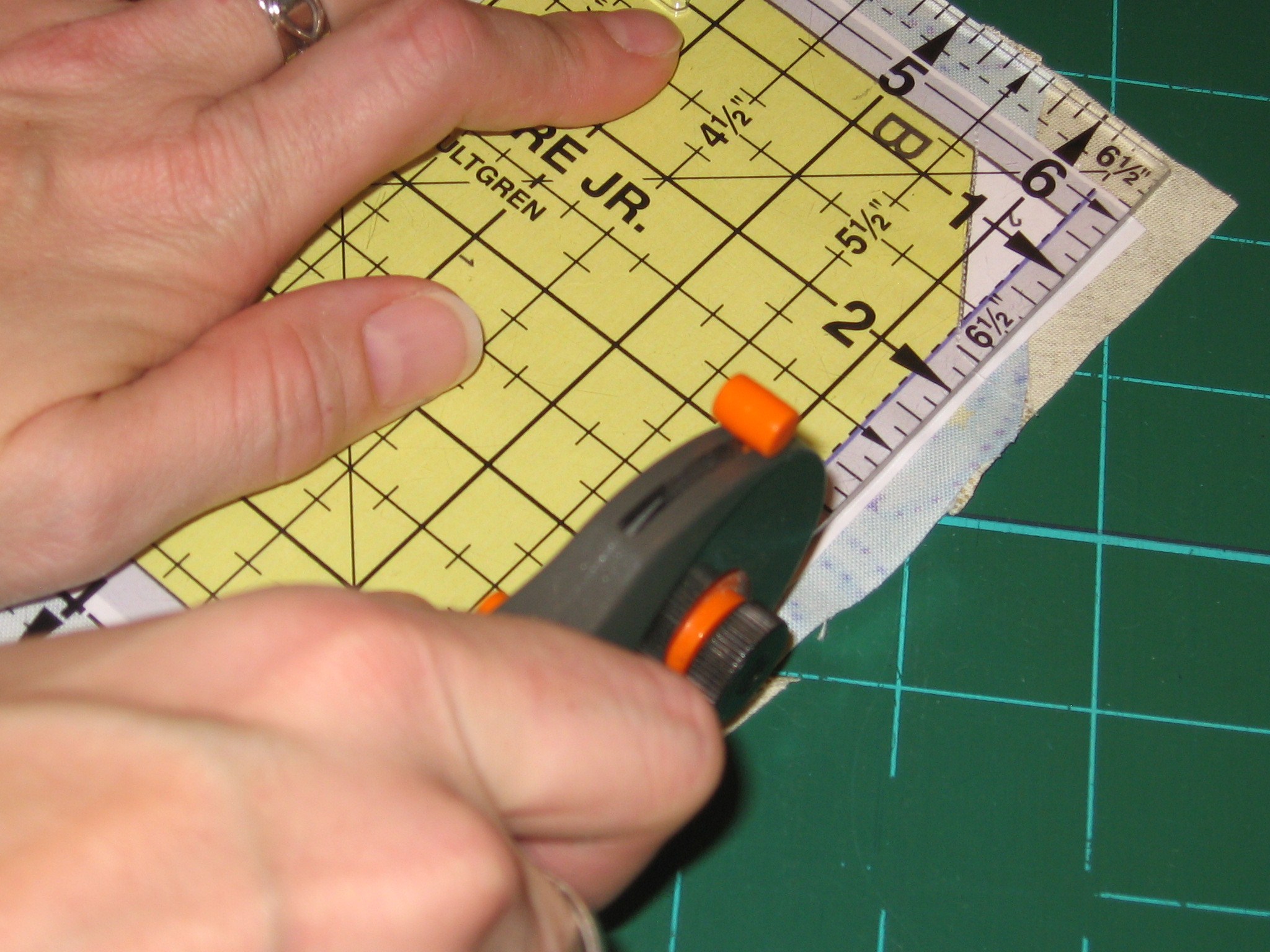
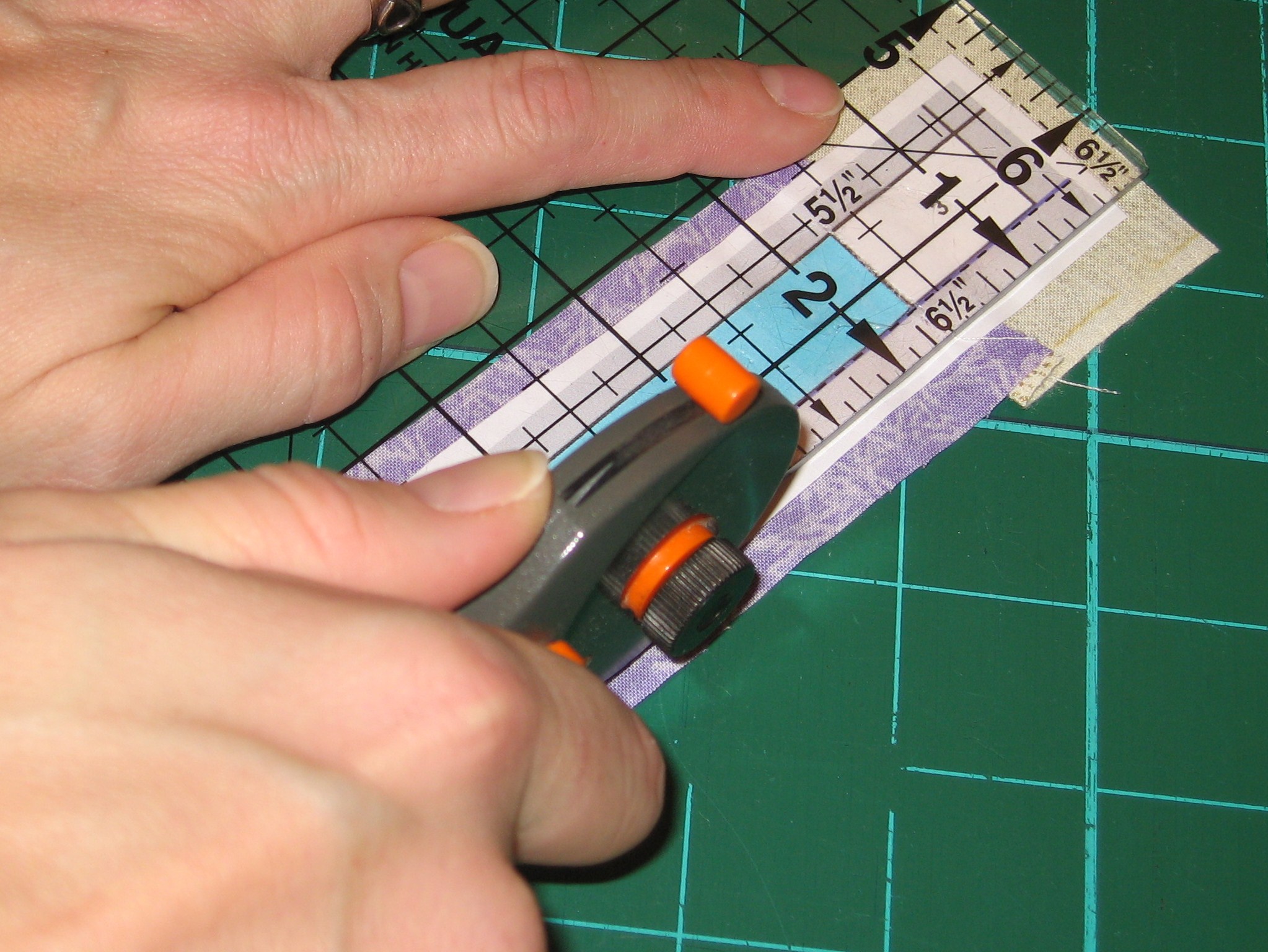
Trim the top, bottom, and sides so they are straight and will be easy to sew. Rotary cutters work perfectly for this if you’ve got one, otherwise a chalk, ruler, and scissors work just fine, too.

Hem both of the short ends. Turn under 1″ and then again 1/4″ or 1/2″ to make a sturdy seam. Stitch with a straight stitch.

As evenly as possible, align the fabric on the book inside out, with the hemmed edges inside the book cover.

Pin the fabric, leaving enough fabric for seam allowance and hemming later. The pinned corners should be approximately 1/16″ of an inch away from the outside of the book. It’s very important to not pin too far away from the book’s edge or the cover will be too loose. 

Using a straight edge, mark along the pins in chalk.

Stitch on chalk or pencil line for all four corners. Reinforce the stitching line several times. These will have a lot of pressure on them from the book being opened and closed.

Trim corners and the short piece of fabric where you have just stitched. Repeat for all corners. Turn, using a chopstick or crochet hook to push out the corners.

The seam allowance along the edges are at this point still unstitched. Press these, using the already-turned corners for your measurement. Turn the hem under (opt) and pin in place if needed.

Start under the flap then straight stitch along the hem, finishing after the next flap. You do not need to stitch all the way to the end, but it’s a good idea to reinforce the hem past the flap so the fabric will lay nice and flat.

Trim your threads and slip your new fabric book cover on!

As long as your book cover is nice and tight, it’ll stay on with no problem.

Now, who wins for best dressed math book?!

Happy sewing!

Find my free patterns on Sewhooked & Fandom in Stitches.

♥ Jennifer O

Posts on this blog may contain affiliate links to help cover the cost of my website. I thank you for your generous support. ♥

Way Back Craft: Marble Backsplash


Once upon a time, we were renters. Every place we lived in belonged to someone else. The color and interest we had were from fabrics and furniture. I could not wait until we had our own place so we could add and change color whenever we pleased!

One of the first projects for my kitchen when we moved in nine years ago was a backsplash. There was originally nothing behind the sink except wall. The paint was peeling and just kind of nasty. I had been collecting different colors of florist marbles and the two came together one night in a stroke of inspiration. It’s been about eight years now and the backsplash still looks as good as it did then!

D-I-Why? Well, because it’s my house and I can!

Marble Backsplash
© Jennifer Ofenstein
http://www.sewhooked.org

● Clean, dry scrub brush
● Florist marbles (flat on one side), washed and dried
● Tile Adhesive in a tube
● Pre-mixed grout
● Sponge
● Grout Sealant
● Latex Gloves (optional)

1. Scrub off loose paint with a dry brush.

2. Using tile adhesive and marbles of your color choice (the amount depends on the size of your space), apply in a pattern or design pleasing to you, leaving a small (about 1/4″) gap between marbles.

3. Allow to dry according to label instructions.

4. Using fingertips (with latex gloves if you like), apply premixed grout. It only takes a small amount. This and the adhesive can be found in the flooring department of your local home improvement store.

5. Smooth grout until it fills all the gaps.

6. Following manufacturer’s instruction, use a damp sponge to wipe grout from marbles.

7. After proper drying time, apply a grout sealer, following manufacturer’s instructions. It’ll make your grout last longer and help it stay cleaner.

Additional information: The window surround is not grouted. The windowsill was contoured using Plaster of Paris to make it look more like stone. This was painted over with the same color as the wall paint.

The beautiful stained glass was made by my mother-in-law, Carol Ofenstein.

This is part of my “Way Back Craft” series’; patterns, crafts, tutorials and general crafty memories before the days of the blog.

also published on cut out + keep

Get Back Jack!


Once upon a time, I had a kindergartner. That kiddo was five years old, and my oldest child. Halloween was, and had always been, our favorite holiday. When it rolled around, I wanted to make something to share with the class. It needed to be easy, child-friendly, and cute.

Jack was born, as were about 20 of his brothers.

It was eight years ago now and my then five-year-old is thirteen and about to start eighth grade. Times have changed, but Jack is still easy, child-friendly…and cute!

also makes a great magnet or pencil topper!

  • Small amount worsted weight yarn: Orange, black, green
  • H hook
  • tapestry/yarn needle

Pumpkin Body:

With orange, make 2 (for fridgie, make 1):

Ch 4, dc in 4th ch from hook 11 times. Join with sl st in top of ch 3. Leave a tail about 8″ long for stitching later.

Jack-o-lantern face:

Using black yarn with yarn needle, make Jack-O-Lantern face on one circle. Finish off.

Joining the the halves:

Using tail, and a yarn needle, join two circles by whipstitching through both sc. Leave an opening at the bottom large enough to put your finger or a pencil inside the pumpkin. Finish off.

Stem:

With pumpkin facing you, sl st in sc one st to the right of center. Sc in next st, sl st in next. Turn. (Do not ch 1) Sl st in next two st. Ch 5, sl st in 2nd ch from hook. Sl st in next 3 ch, sl st again in base sc. Finish off.

If making a magnet or fridgie, only make one circle before adding the stem and then glue a magnet to the back.

Happy Crafting!


signature-2016

Posts on this blog may contain affiliate links. Thank you for your support. ♥

Yarn Ball Cozy from a CD Canister

Yarn Ball Cozy from a CD Canister

queue this pattern on ravelry!

printable pattern

I had one of those “I could make that!” moments at the craft store this weekend. The culprit was a yarn cozy, big enough to hold one ball or small skein of yarn. My daughter and I were looking over the apparatus, which cost approximately $13. It had a clear plastic bottom with a drawstring top. The plastic bit reminded me strongly of a pile of recyclables I’ve been saving for just such a purpose! If you’ve ever bought a value-sized package of writable cds or dvds, you know just what I’m talking about. I’ve used the lid from one for ages to keep my balls of yarn from dancing around and enticing my cats. Take it a step further, and it’s a cozy caddy and cute, too!

You’ll need:

  • small amount of worsted weight yarn (I used cotton)
  • one cd or dvd value-sized container lid
  • F Hook
  • G or H Hook
  • Drill or dremel, with 1/4″ or slightly larger bit
  • Masking tape
  • scissors
snip off the tabs measure out tape around container
Snip off the tabs off the sides of the lid that would hold it in the base. Measure out masking tape around the container. Tear off enough to have a small overlap.

add 1/2" marks to tape yarncaddy 004.JPG
Add 1/2″ marks along the tape. Stick on the lid approximately 1/2″ from the top, being careful to keep it even.

yarncaddy 005.JPG yarncaddy 007.JPG
Drill holes along the 1/2″ marks on the tape. Just a quick warning here: I broke a hole punch in my enthusiasm to make this project. Use a drill if you have one, putting a piece of scrap wood behind the plastic to catch the drill bit when it pops through. And please be careful, power tools are, after all, power tools!

yarncaddy 010.JPG yarncaddy 012.JPG
Row 1: Using a hook that will fit through the hole (I used an F, but you can go larger or smaller depending on the holes), Sl st in any hole. sc loosely around. Sl st to join in beg sc.

yarncaddy 013.JPG
Row 2: Using the larger hook (I changed from F to G), Ch 1., sc in first st. *2 sc in next st, sc in next* around. Sl st in first sc to join.
Note: adapt this row in whatever way you need to in order to have even stitching around the perimeter of the circle.

yarncaddy 015.JPG

Row 3 – 7: Ch 1, hdc in same st, hdc around. Sl st in top of first hdc to join.

Row 8-9: Ch 1, dc in same st and in each st around. Sl st in top of first dc to join.

Row 10: Ch 1, sc around, sl st in first sc to join.

Yarn Ball Cozy from a CD Canister

Row 11: Ch 2, sl st in next sc, *ch 2, sl st in next sc* around. Finish off.

Drawstring:
Ch 75. Pull ends tight, trim to approximately 1″ or weave in ends. For some fun varation, use a ribbon or other trim as a drawstring.

Weave drawstring over and under through every two stitches of Row 8 (first row of dc).

Yarn Ball Cozy from a CD Canister
Your yarn caddy is ready to use!

also posted on craftster and cut out + keep

More Yarn Crafts from Sewhooked!

Add your Sewhooked-related photos to my flickr group and you might be featured in a future post!

Photobucket

Sewhooked Shop | FB | SHFB | Flickr | Twitter


Shop | FB | SHFB | Flickr | Twitter

Funky Crochet Headphone Covers

crochet headphone covers

as seen on the CRAFT blog

queue this pattern on ravelry

Printable Pattern

When we were on vacation, one of the foamy covers from my daughter’s headphones ripped.  We were on a road trip, and I had traveled pretty light, bringing only a bag of DMC floss for making friendship bracelets while we were in the car. I was able to borrow a crochet hook (it was HOT and I’d left my crochet at home!) and whipped up these cute covers for her. The only request she had was “not all one color.”

Size 00 Crochet Hook
DMC Floss (all one color, or pick up different colors as you go)

Chain 2

6 sc in 2nd ch from hook. Sl st in first sc.

Round 1:  ch 1, 2 sc in ea sc around. Sl st in first sc.

Round 2:  ch 1, (sc in next sc, 2 sc in next sc) around. Sl st in first sc.

Round 3:  ch 1, (sc in each of next 2 sc, 2 sc in next sc) around. Sl st in first sc.

Round 4:  ch 1, (sc in each of next 3 sc, 2 sc in next sc) around. Sl st in first sc.

**repeat the pattern until you have a circle the size of your headphone (sc in next 4; 2 sc, sc in next 5, 2 sc, etc) then move on to the next Round**

Round 5:  ch 1, sc in each sc around. Sl st in first sc.

Round 6: ch 1, sc next 2 sts tog around. Sl st in first sc.

Round 7:  ch 1, sc around. Sl st in the first sc.

Round 8:  ch 1, sc next 2 sts tog around. Sl st in first sc.

Finish off.

The size of the initial circle and of the amount of decrease will vary based on the headphones. Compare with the headphone as you go. They should have a really snug fit to keep them from coming off.

More Yarn Crafts from Sewhooked!

Add your Sewhooked-related photos to my flickr group and you might be featured in a future post!

Photobucket

Sewhooked Shop | FB | SHFB | Flickr | Twitter

also posted on Cut Out + Keep and Craftster

featured on the CRAFT blog August 7, 2008
featured project on Cut Out + Keep on August 10, 2008 (screen cap)

free crochet pattern of the day on Daily Crocheter, December 11, 2008